

I Won a $114.48 Stripe Dispute: My Evidence
A Brazilian customer registered, paid, used my SaaS, and then disputed the charge as fraudulent. Here is how I organized account, payment, and product usage records, used Codex to check the evidence, and recovered the full $114.48.
A Brazilian customer registered for my product, completed a payment, and used the paid features. Soon afterward, the payment came back as a Stripe dispute with a fraudulent reason.
I did not accept the chargeback immediately. I arranged the registration, payment, and usage records in chronological order. On August 11, 2026, the Stripe Dashboard showed that I had won the Stripe dispute and that the full $114.48 would be returned.
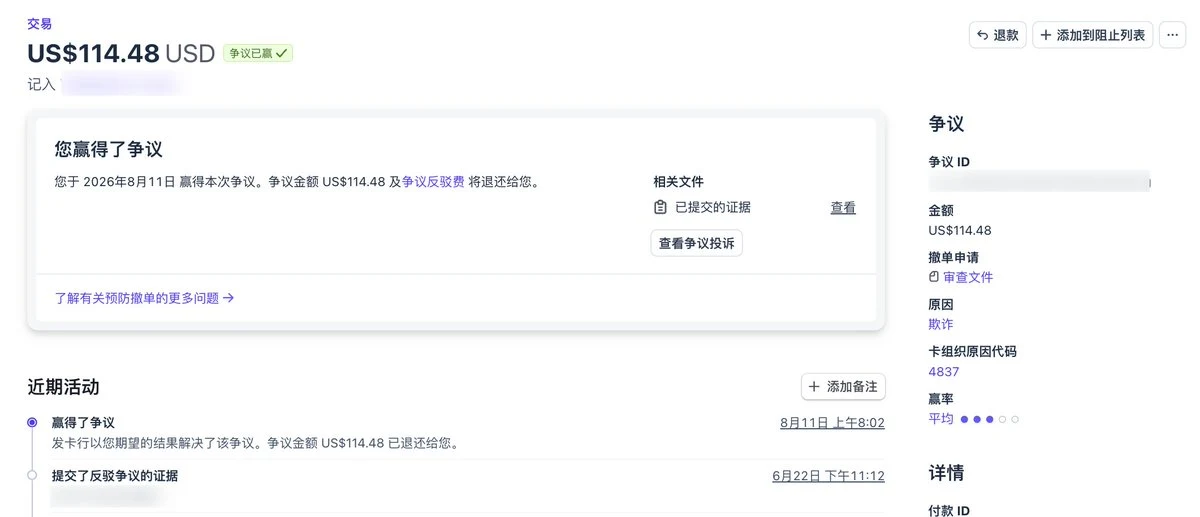
The screenshot shows the result. The Stripe dispute response worked because it connected one customer account, one payment, and the product activity after that payment.
What happened in this Stripe dispute
The product showed the registration time, an internal account identifier, and later activity. The payment system matched the transaction to that same account. The Stripe dispute came down to three questions: Did this account make the payment? Was the service delivered? Was the paid feature used?
The fraudulent reason means the cardholder claimed that they did not authorize or participate in the transaction. A payment screen shows that money changed hands. Product records also show whether the service was delivered and whether someone continued to use the account.
Stripe's guide to dispute reason codes and evidence lists login, download, and post-purchase usage logs as useful digital product records. Every Stripe dispute still needs a response that matches its own reason code.
The Stripe dispute evidence I submitted
I kept the response focused on three groups of records instead of uploading every admin screenshot I could find.
Account registration records showed a redacted identifier, registration time, and account state. I kept only details needed to connect the Stripe dispute records and removed unrelated personal information.
Payment records showed the amount, time, product, and transaction identifier. This section connected the $114.48 payment to the registered account.
Product usage records showed logins after payment, the paid feature used, and activity times. A digital service has no delivery signature, so reliable usage logs can provide evidence of delivery and consumption.
I arranged one timeline: registration, payment, product entry, paid feature usage, and the later Stripe dispute. The reviewer did not have to infer relationships between separate screenshots.
More evidence is not always better evidence
A chargeback makes it tempting to upload every log, email, and screenshot. Stripe's evidence best practices recommend a chronological, concise response in which each item addresses the cardholder's claim.
I started with a one-page Stripe dispute explanation. Each record answered one question: Who created the account? Which payment purchased the service? What happened after payment? Screenshots kept labels, timestamps, and relevant states while hiding unrelated customer data.
External links cannot replace an evidence file. Important information must appear inside the Stripe dispute material. I also label time zones consistently so events do not appear out of order.
How Codex helped me organize the response
Codex turned scattered records into a structure I could review. I did not provide a database dump or Stripe secret key, only the minimum redacted data for this Stripe dispute.
I asked Codex to order the events, identify what each item proved, and flag mismatched customer IDs, payment IDs, amounts, or timestamps. I verified every line in the source systems.
Codex cannot fill gaps with plausible details. If the product never collected a device ID, IP address, or customer communication, I do not infer it. The final review checks redaction, time zones, amount, and Stripe dispute reason.
Stripe's documentation for responding to disputes says a Dashboard response has one submission opportunity. Files cannot be edited or added afterward. A Codex draft is a checklist, not the final authority.
Why I am watching Brazilian orders more closely
I recently saw several similar Brazilian orders. The customers registered, used the product normally, and then opened a Stripe dispute. This is a small sample from my business, not evidence that Brazilian customers as a group are fraudulent.
Country is only a supporting signal. I watch for a high first payment, rapid resource use, payment and login location mismatches, or one payment method across several new accounts.
Higher-risk orders can use Stripe Radar signals, 3D Secure, velocity checks, and consumption limits. A normal order should not be rejected solely because of its country.
What I changed after winning the dispute
This Stripe dispute exposed the cost of scattered records. Important events now carry a linkable customer ID, payment ID, timestamp, and time zone.
Receipts and statement descriptors should be recognizable. Activity records can show when a feature started, whether it completed, and what paid resource was consumed. I still keep only data with an operational, fraud, or compliance purpose.
My Stripe dispute routine is short: read the reason and deadline, check for real unauthorized use, export necessary records, build the timeline, redact unrelated data, and review before submission. The issuing bank still makes the final decision.
Do not panic when a Stripe chargeback arrives
When a customer registered, paid, and used a digital product, start with existing records. Registration connects the account, payment data connects the order, and product logs show delivery and use.
I submitted authentic, redacted records that matched each other and recovered the full $114.48. Codex reduced the organizing time. The product's own records still won the Stripe dispute.
This article describes one Stripe dispute completed on August 11, 2026. Card network, reason code, and regional requirements can differ. Check the deadline shown in the Stripe Dashboard and the current official documentation before responding.