

Why Higher SaaS Pricing Can Lower Churn
Tibo explains how SaaS pricing filters customer fit, changes buyer behavior, and can reduce churn when every increase is backed by product value.
Higher price, lower churn. It sounds backward until you look at what pricing changes before a customer ever reaches the cancellation screen.
We launched Tweet Hunter at $9 per month, then raised the price gradually: $9, $19, $29, $39, and $49 in roughly 12 months. Pricing increased by more than 400%, while churn went down. The lesson was not that an expensive product automatically retains customers. It was that SaaS pricing filters who signs up, why they sign up, and how seriously they try to get value.
I first shared this lesson in my original pricing and churn post. It only works when the product delivers what it promises.
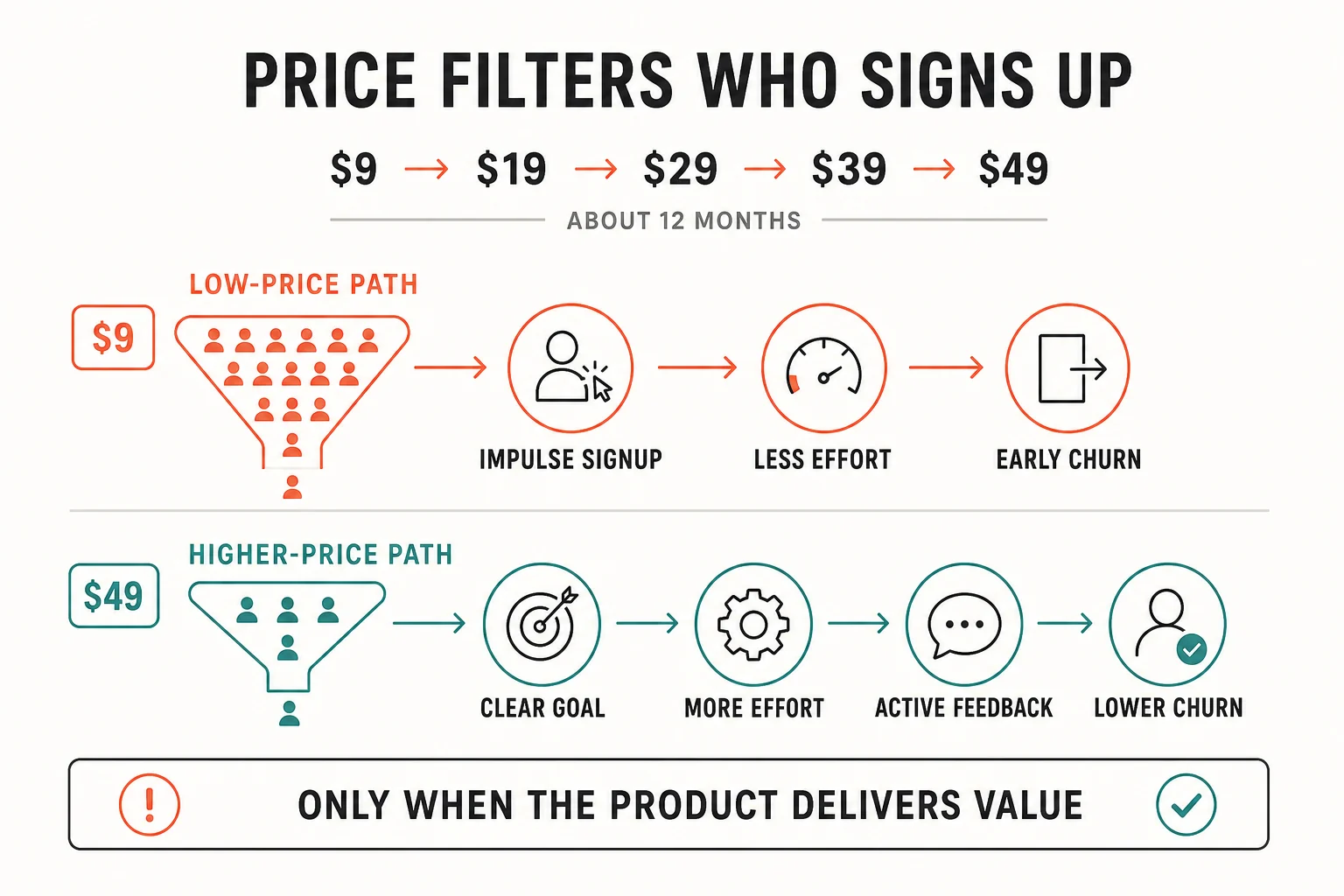
Pricing decides churn at signup
Most founders study churn at cancellation. I think the decisive moment often comes earlier. Pricing is a psychological filter at signup.
At $9 per month, a buyer can treat the product like an impulse purchase. They may be curious or willing to try it without a concrete goal. If the first session is not immediately useful, cancelling is easy. Low pricing attracts many people who were never a strong fit.
At $49 per month, the buyer changes. That SaaS pricing signals a serious tool for a real job. The customer is more likely to arrive with a goal, spend time learning the workflow, and contact support when something blocks them. The price did not magically improve retention. Pricing changed the cohort.
The buyer changes when pricing changes
A cheap user and a premium user do not simply pay different amounts. They can behave like different customers.
The $9 buyer often explores first and looks for value later. The $49 buyer is more likely to define the outcome before buying. When the product is confusing, the second buyer may open a support ticket instead of disappearing. Those tickets reveal friction and product gaps the team can fix.
That is why pricing analysis should include more than revenue. Compare retention, engagement, refunds, and customer type. A higher-pricing cohort that stays longer and uses the product more deeply may be a better fit.
Cheap pricing can be the expensive choice
Low pricing does not guarantee low service cost. In my experience, the cheapest customers can generate the most unreasonable feature requests, the most support work, and the most refunds, while contributing the least revenue to cover any of it. I see this directly while supporting six products.
Pricing also changes what the company builds. A large low-price cohort can pull the roadmap toward convenience requests instead of the outcomes committed customers need. SaaS pricing shapes the users you hear from and the work you prioritize.
Raise pricing slowly and keep shipping
Moving from $9 to $49 overnight is different from moving across those pricing steps during a year of visible product improvement. Tweet Hunter shipped a lot while the price rose. Each increase made more sense because the product had more capability, reliability, and proof.
The practical method is simple:
- Raise pricing in measured steps rather than making one dramatic jump.
- Ship meaningful product value between those steps.
- Track each pricing cohort's retention, engagement, support load, and refunds.
- Stop if pricing gets ahead of the value customers can actually receive.
This creates evidence. You can see whether stronger retention comes from a better customer mix, product improvement, or the lock-in created by an older rate.
Keep existing customers on their old pricing
I would not change pricing for existing users. A grandfathered rate is a strong retention lever because leaving means losing a price the customer cannot get back. It also rewards people who supported the product earlier.
But do not confuse that effect with product-market fit. Split churn by old and new pricing. If the grandfathered cohort stays only because the old rate is valuable, that is pricing lock-in. If the new cohort also stays, engages, and gets results, that is stronger evidence of fit.
“Too expensive” usually means “not enough value”
When “too expensive” appears as a cancellation reason, it is often the polite version of “I stopped seeing enough value.” Discounting pricing may delay the cancellation without solving the underlying problem.
Ask what changed. Did the customer reach the promised outcome? Did usage stop after an onboarding failure? Did the need disappear? Is the buyer outside the ideal customer profile? Pricing is justified when the product creates more value than it captures. If that equation no longer works, either the product is under-delivering or the customer is a poor fit.
There is also a threshold where pricing leaves impulse territory and enters budget review. The Outrank agency plan is $1,499 per month. At that level, nobody forgets the subscription. It is reviewed deliberately as an active expense, so value must be visible every month.
The pattern across my SaaS products
The pattern appeared beyond Tweet Hunter. Revid was acquired as Typeframes with one-off video purchases and roughly 30% churn; rebuilding it as a serious subscription produced a much stronger business. Outrank launched at $99 per month with premium positioning. I reported LTV up 33%, churn down about 20%, and MRR growing from $120,000 to more than $300,000. SuperX moved from a $29 early rate to $49 after users had time to lock in the original pricing.
These are operating examples, not a universal pricing law. A high price on a weak product produces refund requests, not loyalty. Pricing amplifies the fit and value already present; it cannot manufacture either one.
Run the cohort comparison today
Pull up your cheapest pricing cohort and your most expensive pricing cohort. Compare retention, engagement, support tickets, refunds, activation, and user type. Look at what customers were trying to accomplish when they signed up, not only what they selected when they left.
The goal is not to prove that higher pricing is always better. The goal is to find the pricing that admits the right customers, funds the support they need, and matches the value your product consistently delivers.